

16th Sep 2026
Soap vs. Enzymes: How Do They Actually Clean?
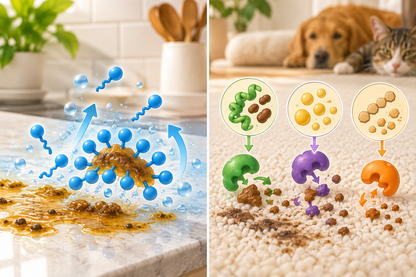
We use soap and cleaning products every day, but have you ever stopped to wonder what they are actually doing?
After all, water is pretty good at washing away things like dust and mud. But add grease, food, body oils, pet accidents, or stubborn odors, and suddenly water alone isn't enough.
That is where chemistry—and sometimes biology—comes in.
Soap Helps Dirt Let Go
One of the most important ingredients in soaps and detergents is a type of molecule called a surfactant.
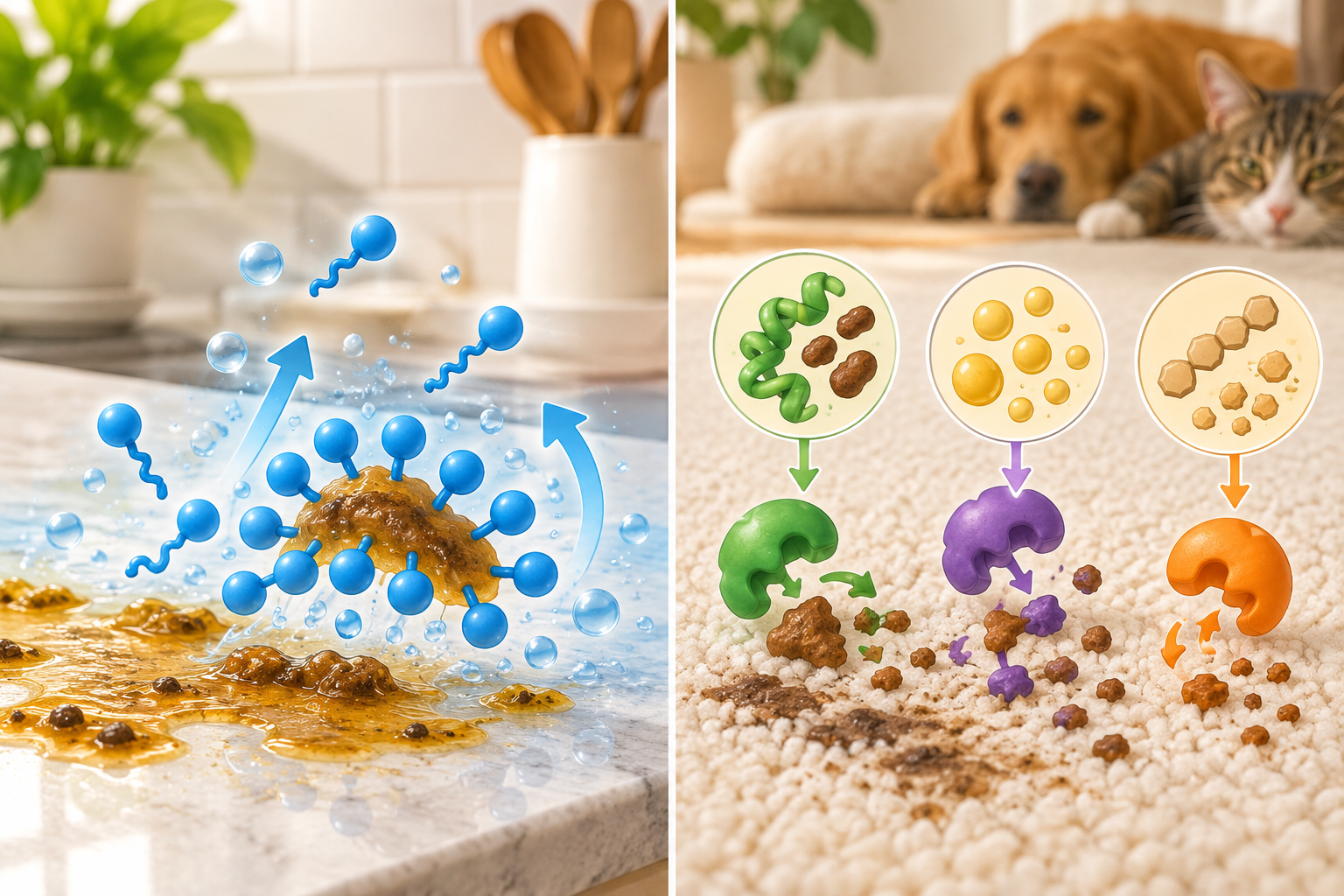
Surfactants have an interesting trick. One part of the molecule interacts well with water, while another part interacts well with oils and grease.
Normally, oil and water don't mix. That's a problem when you're trying to wash something greasy with water. Surfactants help bridge that gap, surrounding oily material and helping it become suspended in the water so it can be rinsed or wiped away.
In simple terms:
Soap helps dirt let go.
But there's another part of cleaning that's easy to overlook: once you've loosened the dirt, you still have to get it out of there.
Think about wiping a dirty kitchen surface with a damp cloth. The first pass may look pretty good. Now take a fresh, clean cloth and wipe the same surface again.
Sometimes that second cloth comes away surprisingly dirty.
The first pass softened and loosened the grime. The second pass picked up more of what had been left behind.
That's why rinsing, wiping, extracting, or laundering is such an important part of cleaning. Loosening dirt and removing dirt aren't necessarily the same step.
Enzymes Do Something Different
Enzymes aren't soaps.
Enzymes are proteins that act as catalysts. That means they help particular chemical reactions happen more easily and quickly.
You can think of an enzyme almost like a tiny specialized tool. Instead of simply helping oily grime mix with water, an enzyme can help break certain large organic molecules into smaller ones.
And different enzymes specialize in different jobs.
Proteases help break down proteins. Lipases work on fats and oils. Amylases work on starches. Other enzymes have their own specialties.
This is particularly interesting when cleaning messes that come from living things.
Food, perspiration, body oils, pet messes and many household odors contain organic material. Instead of simply covering an odor with fragrance, an enzyme-based cleaner may help break down some of the material associated with the mess.
So, if soap helps dirt let go, another useful way to think about enzymes is:
Enzymes help take certain kinds of dirt apart.
Not All Dirt Is the Same
We tend to talk about something simply being "dirty," but chemically, household messes can be very different.
A greasy stovetop isn't the same as muddy paw prints.
A spilled bowl of cereal isn't the same as perspiration in a shirt.
And a pet accident isn't the same as dust sitting on a bookshelf.
That helps explain why a product that works beautifully for one cleaning problem might seem much less impressive on another. Different cleaning mechanisms are useful for different kinds of messes.
Often, good cleaning involves several things happening together: loosening material from a surface, breaking down some of its components, suspending it in liquid, and then physically removing what remains.
Why Do Some Smells Come Back?
This also helps explain one of the most frustrating cleaning experiences: you clean something, it smells fine, and then a day or two later the odor returns.
Sometimes the visible mess was removed while material remained deeper in a porous surface, carpet, fabric, grout, crack, cushion, or padding.
Moisture and humidity can make lingering odors noticeable again.
Pet accidents are an especially good example. Cleaning the surface of a carpet may make everything look spotless, while some of the original material has traveled farther into the carpet or padding underneath.
In cases like these, adding perfume isn't necessarily solving the underlying problem. Reaching and removing or breaking down the material responsible for the odor is much more important.
Do Enzymes Need Time to Work?
Usually, yes.
A conventional cleaner can sometimes seem almost instantaneous because you're using surfactants, water and physical wiping to pick something up.
Enzymes depend on chemical reactions. They need contact with the material they're acting upon, and conditions such as temperature, moisture, concentration and time can affect their activity.
That is one reason enzyme cleaning can be different from simply spraying something and immediately wiping it dry.
It is also why more isn't automatically better. The goal is to give the cleaning ingredients an opportunity to reach the material you're trying to remove and then follow the directions for the particular product and surface.
What Happens When an Enzyme Cleaner Dries?
Drying generally slows or stops enzyme activity because enzymes need an appropriate environment—including moisture—to effectively interact with their target material.
That doesn't necessarily mean an enzyme has vanished the moment the surface dries. Depending on the enzyme and conditions, some may remain present and potentially become active again when moisture returns. But enzymes can also lose activity over time because of heat, extreme pH, storage conditions, or other factors.
So it's better to think of enzymes as working while the conditions are right rather than as tiny cleaners that remain permanently at work on a dry surface.
Cleaning Is Chemistry, Biology—and a Little Elbow Grease
Perhaps the most useful lesson is that a cleaner doesn't magically make dirt disappear.
Something has to happen to it.
It may be dissolved. It may be loosened from a surface. Oils may be suspended in water. Organic material may be broken into smaller components. And ultimately, much of what you're cleaning needs to be rinsed, wiped, washed, or otherwise carried away.
Understanding that can make us better cleaners without making us obsessive cleaners.
Sometimes the solution isn't scrubbing harder. It's giving the right cleaner enough time to work, reaching the place where the mess actually went, and then doing a good job of removing what has been loosened.
That's part of the thinking behind Kleen Green. Enzyme-based cleaning gives us another tool for dealing with the complicated organic messes that are simply part of living in a house—with meals, laundry, children, pets, and everyday life.
Because when you understand a little about what you're trying to clean, cleaning itself starts to make a lot more sense.