


12th Nov 2026
Enzymatic Lice Treatment vs Chemical Shampoos: Which Works Better?
Last Updated: November 10, 2026
Quick Summary
Enzymatic lice treatment breaks down the proteins in the louse exoskeleton and nit glue, while chemical shampoos use a pediculicide to poison or paralyse live insects. Neither is universally better: the right choice depends on resistance history in your area, the age of the person treated, and how much follow-up combing you will do.
- Chemical pediculicides generally have limited ovicidal activity, so a second application timed to the hatching window is required.
- Repeat chemical shampoos around day 7 to 9 to catch newly hatched lice before they can lay eggs.
- Wet combing with a fine-toothed lice comb is the only step that removes eggs regardless of product used.
- Pyrethrin-based products carry label warnings for people with asthma or ragweed-type plant allergies.
- Wash bedding and hats at 60°C and bag non-washables for two weeks.
Table of Contents
- Enzymatic Lice Treatment vs Chemical Shampoos: The Short Answer
- How Does Lice Shampoo Work? Chemical vs Enzyme Mechanisms
- Chemical Lice Treatment Resistance: What the Evidence Shows
- Does Lice Shampoo Kill Eggs? Nits, Hatching, and Repeat Treatments
- How Fast Does Lice Shampoo Work? Timelines Side by Side
- Safety, Side Effects, and Who Should Avoid Chemical Shampoos
- Application Protocol and Follow-Up Schedule Compared
- Choosing Your Treatment: Which Option Fits Your Household
- Frequently Asked Questions
Enzymatic Lice Treatment vs Chemical Shampoos: The Short Answer
Neither option is universally better. Enzymatic lice treatment works by breaking down the proteins lice and eggs are built from, while chemical shampoos use a pediculicide to poison or paralyse the insects. The right choice depends on resistance history in your area, the age of the person being treated, and how much follow-up combing you are prepared to do.
Here is the honest version. A 2022 review indexed by PubMed Central's history of physically acting lice treatments confirms that head lice worldwide have developed resistance to insecticides, which is exactly why physically acting and enzyme-based products entered the market. That does not make chemical shampoos useless. It means the old assumption that one drugstore bottle solves everything no longer holds. Natural Ginesis offers non-toxic, bio-degradable products for body, home, and pets, and this guide compares both approaches without flattering either.
Below, we break down mechanisms, resistance evidence, egg-killing claims, timelines, safety, and application schedules so you can pick with your eyes open.
How Does Lice Shampoo Work? Chemical vs Enzyme Mechanisms
The two categories work on completely different principles, and that difference explains most of the practical trade-offs.
Chemical pediculicides contain an active ingredient such as permethrin, pyrethrin, or a prescription option like spinosad. These compounds attack the louse's nervous system, either paralysing or killing live insects after a period of contact. The CDC's head lice treatment guidance lists both over-the-counter and prescription pediculicides as accepted options, with instructions that vary by product.
Protease enzymes take a different route. These proteins break down the structural material in a louse's exoskeleton and in the glue that binds nits to the hair shaft. Nothing is poisoned. The insect's outer structure is degraded, and eggs lose their grip. That is why enzyme-based products sit in the physically acting category rather than the insecticide category.
What chemical pediculicides do to live lice
Permethrin and similar actives are generally understood to disrupt nerve signalling in lice. Effectiveness depends on the louse population's resistance status and on correct application, since a rushed or shortened contact time leaves survivors.
What protease enzymes do to lice and nits
Protease enzymes are described as breaking down the proteins in the louse exoskeleton and nit cement. A common mistake is expecting an instant knockdown. Enzymes need the full dwell time stated on the label to do their work.
Chemical Lice Treatment Resistance: What the Evidence Shows
Resistance is the single biggest reason families end up searching for alternatives. A 2025 study summarised by PubMed Central on over-the-counter pediculicide shampoo failure reports that increasing resistance to chemical pediculicides has raised concerns about treatment efficacy, including in Thailand. The same summary does not publish a numerical failure rate, so treat any precise percentage you see quoted online with suspicion.
What the evidence does support is directional: resistance is documented, it varies by region and by active ingredient, and it is the stated reason physically acting treatments were introduced. If your household has already failed two rounds of a drugstore shampoo, resistance is a reasonable first hypothesis rather than a reason to buy a third bottle of the same thing.
One caution. Claims that enzyme products are categorically more effective than chemical shampoos should be treated with caution, since outright superiority is not established in the published literature.
| Factor | Chemical pediculicide | Enzyme-based treatment |
|---|---|---|
| Mechanism | Nervous system disruption | Protein breakdown of shell and nit glue |
| Resistance risk | Documented, varies by region | No insecticide resistance mechanism |
| Speed of kill | Hours after correct application | Depends on full dwell time |
| Nit action | Limited; combing usually needed | Softens nit cement |
| Typical follow-up | Repeat in 7-9 days | Repeat per label, comb between |
| Best for | First-line cases in low-resistance areas | Households with prior treatment failure |
Does Lice Shampoo Kill Eggs? Nits, Hatching, and Repeat Treatments
Most shampoos do not reliably kill eggs, and that single fact explains most treatment failures. A product can clear every live louse on day one and still leave a household reinfested when surviving nits hatch seven to ten days later.
Killing eggs (ovicidal activity). Chemical pediculicides generally have limited ovicidal activity. Permethrin-based products are not considered reliably ovicidal, and even products with some egg-killing action are not trusted to catch every egg at every stage of development.
Weakening nit glue. Enzyme-based products target the protein cement that binds nits to the hair shaft. The practical result is that eggs release from the hair more readily during combing. That is a real benefit, but it is not the same as destroying the embryo.
Physically removing nits. Wet combing with a fine-toothed lice comb is the only step that removes eggs from the head regardless of which product you used. Combing is generally where treatment outcomes are decided, because it catches both missed live lice and eggs that survived treatment. Neither chemical nor enzyme products replace it.
Watch out: marketing language that says a product "dissolves eggs" or "kills nits" should be read carefully. Weakening the glue so eggs release is a legitimate mechanism, but it is not the same claim as killing the embryo inside, and the published literature does not support treating enzyme products as fully ovicidal.
The repeat-treatment calendar follows from this. Chemical shampoos are typically repeated around day 7 to 9 to catch newly hatched lice before they can lay eggs. Enzyme products are repeated per the label, with combing in between. In both cases, the second session is not optional insurance, it is the step that closes the hatching gap.
How Fast Does Lice Shampoo Work? Timelines Side by Side
Contact times differ between products, so follow the dwell time stated on each label.
Neither option is instant in the way parents hope at 9pm on a school night. Expect to block out an evening: application, dwell, rinse, and a full comb-through. Plan the repeat session before you start, because the calendar gap matters more than the clock.
Safety, Side Effects, and Who Should Avoid Chemical Shampoos
Chemical pediculicides are regulated pesticides, so label instructions and warnings should be followed closely. Common adverse effects include scalp irritation, itching, redness, and burning, particularly with repeated use, on broken skin, or on sensitive scalps.
A practical decision guide matters more than a general warning list.
Infants and very young children. Many pediculicides have minimum age limits on the label, and these vary by active ingredient. Check the specific product rather than assuming all over-the-counter shampoos are suitable for a toddler.
Pregnancy and breastfeeding. Some active ingredients are preferred over others in pregnancy, and the choice depends on the product and the stage of pregnancy. This is a conversation for a pharmacist, midwife, or doctor rather than a decision made from a shelf label.
Asthma and sensitive airways. Pyrethrin-based products carry label warnings for people with asthma or allergies to ragweed-type plants. If anyone in the household has asthma, read the label before opening the box and consider a physically acting option first.
Known allergies and eczema. Anyone with a known allergy to an active ingredient or to a carrier in the formula should avoid that product.
Broken skin, open sores, or secondary infection. Do not apply a pediculicide to broken skin. Persistent scratching can cause a secondary bacterial infection, and that warrants medical attention rather than another treatment round.
Treatment failure and repeated exposure. Repeatedly applying the same chemical after a failed course increases exposure without increasing the chance of success, especially where resistance is likely.
The trade-off with enzyme-based and other physically acting products is honest: avoiding insecticide exposure is a genuine advantage for sensitive households, but "natural" is not a guarantee of zero reaction.
Application Protocol and Follow-Up Schedule Compared
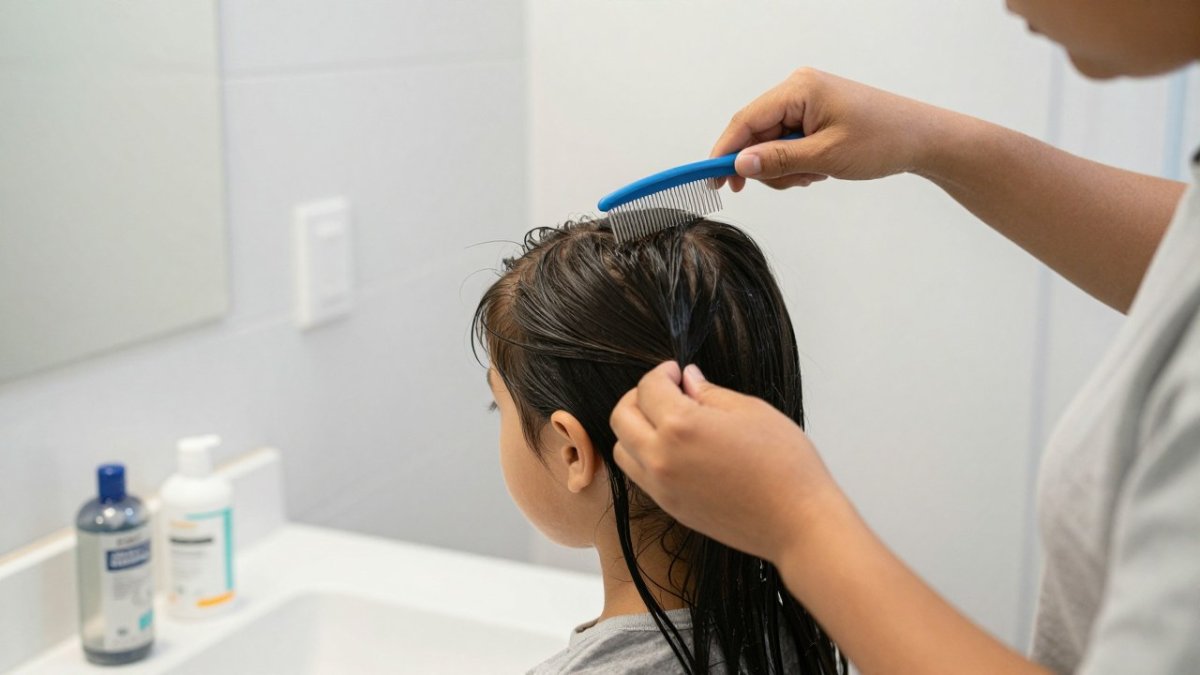
Here is the side-by-side schedule we would follow at home.
| Stage | Chemical shampoo | Enzyme treatment |
|---|---|---|
| Day 1 | Apply to dry hair, leave per label, rinse, comb | Apply, allow full dwell time, rinse, comb |
| Day 1-2 | Check for live lice after 8-12 hours | Check scalp, comb sections |
| Day 7-9 | Mandatory second application | Second application per label |
| Day 10-14 | Comb every 2-3 days | Comb every 2-3 days |
| Day 14 | Confirm no live lice before stopping | Confirm no live lice before stopping |
- Treat every affected household member on the same day
- Wash bedding and hats at 60°C, and bag non-washables for two weeks
- Soak combs in hot water after each session
- Comb-check the whole household weekly for a month
- Notify the school so contacts can be checked
Choosing Your Treatment: Which Option Fits Your Household
Pick a chemical shampoo if this is a first infestation, you have no resistance history, and every person being treated is old enough and healthy enough for the label's warnings.
Pick an enzyme-based treatment if you have already failed a chemical course, if the person being treated is very young, pregnant, asthmatic, or has a sensitive scalp, or if you simply prefer to avoid insecticide exposure in your home. Natural Ginesis offers non-toxic, bio-degradable products designed for body, home, and pets. Pricing depends on the products and quantities you choose; check our website for current details. What most guides miss is that the follow-up schedule matters more than the product label. Whichever route you take, the comb and the calendar do the heavy lifting.
The hard part is not choosing a bottle. It is committing to the full two-week schedule when the head looks clear on day three. Natural Ginesis makes that easier with non-toxic enzyme formulas that are safe for the whole family, bio-degradable ingredients, and kits that cover body, home, and pets in one order. Get started with Natural Ginesis and treat your household without harsh chemicals.
Frequently Asked Questions
Are enzymatic lice treatments as effective as chemical shampoos?
The supplied research does not include a head-to-head trial proving enzyme products outperform chemical shampoos. What it does show is that insecticide resistance has made some chemical pediculicides less reliable, which is why physically acting and enzyme-based options were introduced. Effectiveness for either route depends on following the application instructions and repeating treatment at the correct interval so newly hatched lice are caught. Ask any brand for its evidence before buying.
Does lice shampoo kill eggs?
Most chemical pediculicides target live lice and have limited effect on eggs, which is why a second treatment about 7 to 9 days later is standard guidance. Enzyme-based products work on the shell and the glue that attaches nits, but no treatment removes every egg, so combing with a fine-toothed comb remains essential. Plan on nit removal by comb as part of any protocol, chemical or enzymatic.
Why might an over-the-counter lice shampoo fail?
Resistance to chemical pediculicides has raised concerns about treatment efficacy in some regions. Failure can also come from misapplication, skipping the repeat treatment, or reinfestation from untreated family members and bedding. If two correctly applied courses of a chemical shampoo fail, switch approach rather than repeating the same active ingredient.
How fast does lice shampoo work?
Chemical pediculicides are generally used against live lice, and eggs may survive and hatch later, so the visible result is not necessarily the end of the infestation. Results for either approach depend on following the label and on combing. Whichever you choose, judge success at the follow-up check roughly a week later, not on day one.
Is enzymatic lice treatment safe for children and sensitive scalps?
Households with sensitive skin often look at enzyme-based and other physically acting products first. That does not make any product risk-free: check the label for allergens and patch test if your child reacts easily. For infants, pregnancy, or known allergies, confirm suitability with a pharmacist or doctor before treating.
