

20th Nov 2026
How Do You Treat Fleas on Puppies Safely?
Last Updated: October 25, 2026
Quick Summary
To treat fleas on puppies safely, start with the puppy's age and weight, not the first product on the shelf, because most flea products carry a minimum age and weight on the label. Puppies under 8 weeks should get physical removal only, such as a flea comb and warm bath, unless your vet prescribes a medicated product.
- Read the weight band first, then the age limit, then the species on every product label.
- Never split a large-dog dose, because the dose is not linear.
- Comb before bathing, since wet fur lets the comb glide past fleas.
- Do not bathe the puppy for a couple of days after applying a spot-on.
- Expect to keep finding some fleas for two to four weeks after you start.
Table of Contents
- Why Fleas Hit Puppies Harder Than Adult Dogs
- Flea Treatment for Puppies by Age and Weight
- How to Remove Fleas From a Puppy With a Flea Comb
- Bathing, Spot-Ons and Where to Apply Them
- How Often to Treat a Puppy for Fleas
- Getting Rid of Fleas in the Home With Pets
- How to Tell Whether the Treatment Is Working
- When to Call Your Vet About Puppy Fleas
- Frequently Asked Questions
Why Fleas Hit Puppies Harder Than Adult Dogs
Fleas are small, wingless insects that feed on blood, and a puppy's small body makes every bite count more.
Owners often spot a few fleas, wait a week, and suddenly the puppy is scratching raw patches into its skin.
Puppies are also more likely to pick up fleas in the first place.
Three risks stand out for young dogs:
- Blood loss and anemia in heavy infestations, especially in small breeds
- Skin irritation and infection from constant scratching
- Tapeworm risk, since fleas carry tapeworm larvae a puppy can swallow while grooming (Dipylidium caninum in the twenty-first century)
If you are wondering how to treat fleas on puppies, the answer starts with the puppy's age and weight, not with the first product on the shelf.
Flea Treatment for Puppies by Age and Weight
Flea treatment for puppies by age and weight is the single most important decision you will make. Most flea products carry a minimum age and a minimum weight on the label, and those limits exist for a reason. A product that works safely on a six-month-old Labrador is not automatically safe for an eight-week-old Chihuahua. Body weight affects how a dose behaves, and age affects how well a puppy's liver and skin can handle it.
Use this decision guide as a starting point, then confirm every choice against the actual product label and your veterinarian:
| Puppy Age and Weight | Safe First-Line Options | What to Avoid |
|---|---|---|
| Under 8 weeks, any weight | Physical removal only: flea comb, warm bath with mild soap, bedding changes, vacuuming | All medicated flea products unless your vet specifically prescribes one |
| 8 to 12 weeks, within product weight band | Some spot-on and oral products labeled for that age and weight; flea comb and bathing as support | Any product above the puppy's weight band; dog products on cats or kittens |
| 12 weeks and up, within weight band | Wider range of spot-ons, orals, and flea shampoos labeled for the puppy's weight | Splitting large-dog doses; combining products with the same active ingredient |
| Adult weight reached | Full adult product range, still label-checked each time | Assuming a product is safe just because the puppy is now bigger |
Reading the Product Label Before You Apply
Read the weight band first, then the age limit, then the species. Never use a dog product on a cat or a kitten. Never split a large-dog dose to save money, because the dose is not linear. Check for these four things every time:
- Minimum age in weeks
- Minimum weight in kilograms or pounds
- Species the product is licensed for
What most guides miss is ingredient stacking. If you use a spot-on and then a shampoo with a similar active ingredient, you can overdose the puppy without realizing it. A common pattern is an owner applying a spot-on, then bathing the puppy with a medicated shampoo a day later because the itching continues. That combination can increase exposure. When in doubt, space products out and ask your vet before layering treatments.
What to Do When Your Puppy Is Too Young for Medication
When a puppy is too young for medicated treatment, you fall back on physical methods. This is not a lesser option. Done properly, it buys you time until the puppy reaches the label threshold.
- Bathe with warm water and a mild soap, then comb thoroughly
- Remove every flea you find and drop it into soapy water
- Wash all bedding in hot water
Watch out: never use an adult flea product "just a little" on a young puppy. Reactions in small dogs can escalate quickly, and the label limits are not suggestions.
A Quick Weight-Check Rule
Weigh the puppy before every treatment decision, not just once. A puppy can gain enough weight in two weeks to move into a different product band, and using the old dose can under-treat or over-treat. Keep a simple log of date, weight, product name, and active ingredient. That log is also what a vet will ask for if something goes wrong.
How to Remove Fleas From a Puppy With a Flea Comb
Removing fleas with a flea comb is the safest first step for any puppy, at any age.
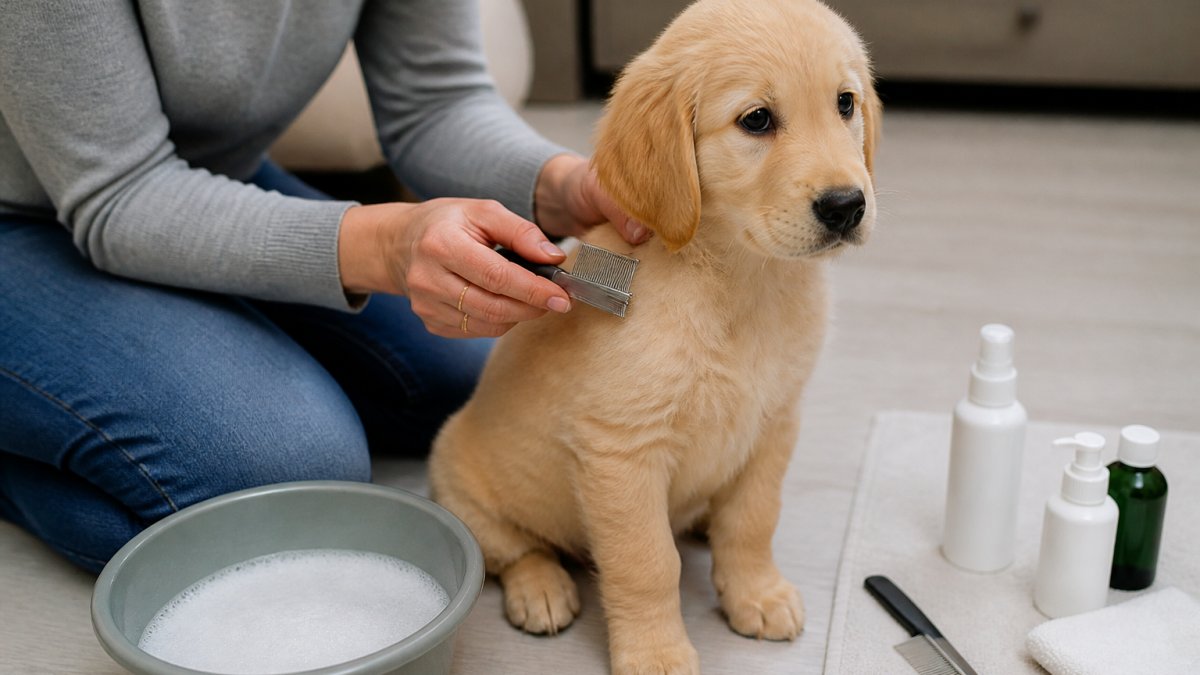
Work through it in this order:
- Fill a bowl with warm water and a drop of mild soap
- Comb along the back, then the tail base, then the belly and legs
- Dip the comb into the water after each pass to drown the fleas
- Wipe the comb on a paper towel to check for flea dirt
- Repeat daily until you find nothing for several days
Flea dirt looks like coarse black pepper. Drop a few specks on a damp paper towel. If they smear reddish-brown, that is digested blood and confirms fleas.
Comb before bathing, not after. Wet fur makes the comb glide past fleas instead of catching them.
Bathing, Spot-Ons and Where to Apply Them
Bathing removes fleas and soothes itchy skin, and a topical treatment keeps working afterward. The trick is getting the order right.
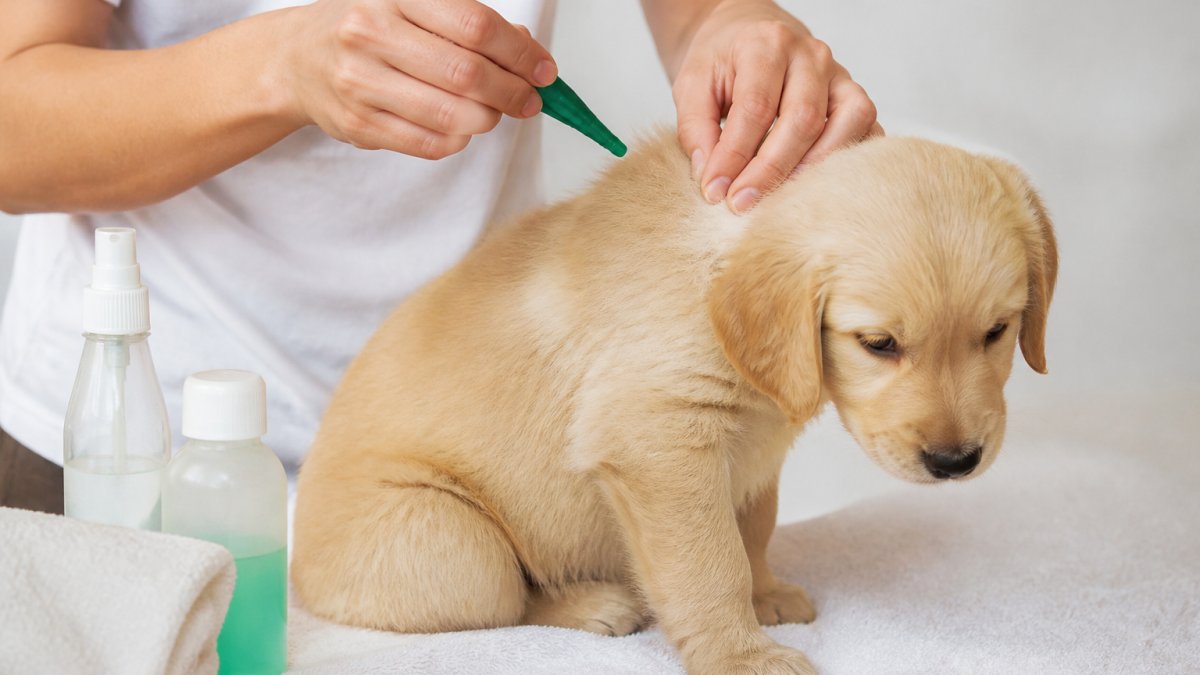
Bathe first with warm water and a mild soap. Dry the puppy thoroughly. Then apply the spot-on.
Where to apply a spot-on treatment:
- Part the fur at the base of the neck, between the shoulder blades
- Place the tip of the tube on bare skin, not on the coat
- Squeeze in one spot the puppy cannot lick
Do not bathe the puppy for a couple of days after applying a spot-on, or you will wash the protection away. Never apply a spot-on to broken or irritated skin.
For puppies too young for medicated products, an enzyme-based pet wash gives you a non-toxic option for the body while you handle the environment separately. At Natural Ginesis, our pet products are built around organic enzyme blends rather than harsh pesticides, which matters when the animal on the other end is small and still growing.
How Often to Treat a Puppy for Fleas
How often to treat a puppy for fleas depends on the product, not on how itchy the puppy looks. Most spot-on treatments are labeled for monthly use. Oral products vary. Shampoos only kill fleas present at the time of the bath and offer no lasting protection.
A workable rhythm looks like this:
- Medicated treatment: follow the label interval exactly, usually every 30 days
- Flea combing: daily during an active infestation, then weekly
- Bathing: as needed for comfort, but not within two days of a spot-on
Do not shorten the interval to "be safe." More frequent dosing is how overdoses happen. If the label says monthly, monthly is the earliest safe repeat.
How to Check Whether Treatment Is Working
You will know treatment is working when the flea count drops week over week, not day over day. Expect to keep finding some fleas for two to four weeks after you start, because new adults keep emerging from the environment. That is normal and does not mean the product failed.
Track these signals:
- Fewer fleas on the comb each session
- Less flea dirt on the paper towel
- Less scratching and fewer raw patches
A simple monitoring method is to comb the puppy over a white paper towel for five minutes at the same time each day, count the fleas you catch, and note the number. A downward trend over two to three weeks is the goal. If the count is flat after a month of correct treatment, something is off. Common causes are missed doses, a product that does not match the puppy's weight, or an untreated source such as a cat or the yard.
Product Safety and Interactions
Flea products are pesticides, and puppies are small. A few safety rules prevent most problems:
- Never use a dog product on a cat or kitten. Some dog flea products are toxic to cats.
- Do not combine products with the same active ingredient without veterinary advice.
- Do not apply a spot-on to broken or irritated skin.
If you suspect an adverse reaction, such as vomiting, drooling, tremors, weakness, or collapse after a treatment, call your vet or an animal poison control service immediately. Do not wait to see if it passes.
Getting Rid of Fleas in the Home With Pets
Getting rid of fleas in the home with pets is where most treatments fail. Adult fleas on the puppy are only a small share of the problem. Eggs, larvae, and pupae live in carpets, bedding, and cracks, and they keep hatching for weeks.
That is the part often overlooked about flea treatment: you are not fighting the fleas you can see. You are fighting the ones you cannot.
A Weekly Cleaning Schedule That Breaks the Flea Life Cycle
- Vacuum all floors, rugs, and under furniture
- Vacuum the car if the puppy rides in it
- Wash pet bedding in hot water
Vacuuming does more than remove dirt. It lifts eggs and larvae and exposes pupae to the surface. Empty the canister every time, or you are just redistributing them.
For the home side, a non-toxic enzyme-based cleaner lets you treat surfaces and fabrics without leaving harsh pesticide residue where the puppy sleeps and plays. This can be a suitable option for households with small children.
How to Tell Whether the Treatment Is Working
You will know treatment is working when the flea count drops week over week, not day over day. Expect to keep finding some fleas for two to four weeks after you start, because new adults keep emerging from the environment.
Track these signals:
- Fewer fleas on the comb each session
- Less flea dirt on the paper towel
- Less scratching and fewer raw patches
If the count is flat after a month of correct treatment, something is off. Common causes are missed doses, a product that does not match the puppy's weight, or an untreated source such as a cat or the yard.
When to Call Your Vet About Puppy Fleas
Call your vet the same day if you see any of these:
- Pale gums, weakness, or collapse
- Vomiting, drooling, or tremors after a treatment
- Skin that is broken, oozing, or smells
Pale gums are the one to take seriously. They can signal anemia from blood loss, which is a real risk in small puppies with heavy infestations.
A vet can also confirm the weight band and pick a product that suits a very young or very small dog. That is worth the visit before you guess.
Frequently Asked Questions
How often should I treat my puppy for fleas?
Most spot-on and oral products are dosed monthly, but the label on your specific product sets the interval, so follow it exactly rather than guessing. In a home with an active infestation, comb your puppy every day and vacuum daily for at least three to four weeks, because flea eggs and larvae in bedding and carpets keep hatching between treatments. Ask your vet before shortening or stretching any interval.
What is the safest way to get fleas off a very young puppy?
For puppies below the minimum age on any flea product label, skip medication and use mechanical removal instead. Stand the puppy on a towel and comb with a fine-tooth flea comb, dipping the comb into warm water with a little mild soap after each pass so fleas drown rather than jump back on. Bathe only with a shampoo labelled for puppies, dry the coat thoroughly, and wash the puppy's bedding in hot water. If the puppy seems itchy, weak or anaemic, call your vet the same day.
Can fleas make a puppy sick?
Yes. Puppies have less blood to lose, so a heavy flea burden can cause anaemia, and flea bites also trigger itchy skin, irritation and secondary infections from scratching. Fleas can carry tapeworm larvae, so a puppy that swallows a flea during grooming may need worming. Watch for pale gums, low energy, constant scratching or hair loss, and contact your vet promptly rather than waiting for the next scheduled treatment.
How do I get rid of fleas in my home when my puppy has them?
Treat the environment and the puppy at the same time. Vacuum carpets, skirting boards and under furniture daily, wash pet bedding and soft furnishings in hot water, and keep the puppy out of the treated rooms until surfaces are dry. Around 95% of a flea infestation sits in the environment as eggs, larvae and pupae, so cleaning matters as much as the product on your puppy. Repeat the full routine weekly for at least a month to catch newly emerging adult fleas.
Fleas on a puppy are stressful, and the guessing game makes it worse. Natural Ginesis makes non-toxic, bio-degradable pest control products for the body, home, and pets, built on organic enzyme blends instead of harsh chemical pesticides. Our formulas help you handle fleas on the puppy and in the home without adding pesticide residue to the spaces where your family lives. Get started with Natural Ginesis and treat fleas safely, from the first comb to the last load of bedding.
