

26th Nov 2026
How to Use Non Toxic Cleaning for Allergen Relief
Last Updated: November 4, 2026
Quick Summary
Non toxic cleaning for allergen relief means removing dust, dander, pollen and mold with products that do not add their own irritants to the air. Choose fragrance-free, dye-free cleaners with a full ingredient list, and use wipes or liquids instead of aerosols. Damp dust, HEPA vacuuming and ventilation matter as much as the product itself.
- Green and homemade cleaners may pose fewer respiratory-health risks than conventional products, per 2022 PubMed Central research.
- Look for fragrance-free rather than unscented, since unscented can mean a masking scent was added.
- Dilute concentrates exactly by the label ratio and never mix bleach with acidic cleaners like vinegar.
- Wash bedding weekly in hot water and damp dust instead of dry dusting to trap allergens.
- A 2024 review found removing carpets or furniture coverings may reduce dust mite and allergen exposure.
Table of Contents
- Why Non Toxic Cleaning Matters for Allergen Relief
- Best Hypoallergenic Cleaning Products for Sensitive Homes
- Asthma and Allergy Friendly Cleaning Products: What to Look For
- Toxic Cleaning Products List: Ingredients That May Trigger Symptoms
- Non Toxic Cleaning Concentrate: Dilution, Storage, and Safe Use
- Room-by-Room Non Toxic Cleaning Routine for Allergen Reduction
- DIY Cleaning Recipes: Safe Use and Limitations
- Choosing Natural Ginesis Products for Your Sensitive Household
- Frequently Asked Questions
Why Non Toxic Cleaning Matters for Allergen Relief
Non toxic cleaning for allergen relief is the practice of removing dust, dander, pollen and mold with products that do not add their own irritants to the air. It matters because the global natural household cleaners market is projected to grow from $8.8 billion in 2026 to $20.99 billion by 2034, according to Fortune Business Insights market forecast.
Here is the part most guides get wrong. They treat "allergen removal" and "product irritation" as the same problem. They are not.
- Allergen removal means getting dust mites, pet dander, pollen and mold out of the house.
- Product irritation means the cleaner itself is bothering your eyes, skin or lungs.
You need to do both. A spotless room cleaned with a harsh spray can still leave a sensitive person sneezing.
Research published in PubMed Central on green and homemade cleaning products (2022) suggests green and homemade cleaners may pose fewer respiratory-health risks than conventional products. That is a real reason to switch. But it is not a free pass, and we will show you where the limits are.
Best Hypoallergenic Cleaning Products for Sensitive Homes
The best hypoallergenic cleaning products for a sensitive home are fragrance-free, dye-free and labeled with their ingredients.
What most shoppers miss is that "natural" and "hypoallergenic" are not the same claim. A product can be plant-based and still set off a reaction.
Our shortlist of what to keep in the cupboard:
- A fragrance-free surface cleaner for hard surfaces
- A dye-free dishwashing detergent
- A plant-based laundry detergent with no added perfume
- A simple glass cleaner with no ammonia smell
- Microfiber cloths and a HEPA filter vacuum
The U.S. EPA guidance on buying green cleaning products makes the same point: check ingredients and environmental certifications rather than trusting broad green claims.
That warning is why we tell customers to patch test anything new. A short list of safe-looking products beats a cupboard full of unknowns.
Asthma and Allergy Friendly Cleaning Products: What to Look For
Asthma and allergy friendly cleaning products share four traits: no added fragrance, no dye, a full ingredient list, and a form that does not spray fine mist into the air. Check those four and you filter out most of the risk.
Industry guidance is blunt about one thing: no cleaning product is entirely free of risk, and safety depends on the product and how you use it. "Non-toxic" is a direction, not a guarantee.
So what do you actually look for on the shelf?
- Fragrance-free, not just "unscented." Unscented can mean a masking scent was added.
- Dye-free. Dyes add nothing to cleaning power.
- Full ingredient list. If the label hides the contents, skip it.
- Wipes or liquids over aerosols. Sprays put droplets in the air where you breathe them.
- A recognized certification where one exists in your market.
A practical habit is to test a new product in one room first. If the air feels heavy or your eyes sting, stop.
Toxic Cleaning Products List: Ingredients That May Trigger Symptoms
Several common cleaning ingredients are worth recognizing: strong fragrances, chlorine bleach, ammonia, quaternary ammonium compounds, and aerosol propellants.
We are not saying these ingredients are banned or unsafe for everyone. Used as directed, most cleaning products are safe.
Here is what to watch for on labels, and why each one matters:
- "Fragrance" or "parfum" with no detail. Fragrance is a catch-all term that can cover many individual compounds. A product labeled "unscented" may still contain a masking fragrance, so look for "fragrance-free" instead.
- Chlorine bleach. Bleach is effective for disinfection, but it is not usually needed for routine allergen removal.
- Ammonia. Glass cleaners often contain ammonia, so a fragrance-free, ammonia-free option is a common choice for sensitive households.
- Quaternary ammonium compounds, often listed as "quats." These are common in disinfecting wipes and sprays. They are not usually needed for everyday dust and dander removal.
- Aerosol propellants. Any product that sprays a fine mist puts droplets into the air where you breathe them. Wipes, liquids and pump sprays with a coarse stream are lower-exposure alternatives.
- Strong solvents in degreasers. For light kitchen grease, a plant-based degreaser used with ventilation is usually enough.
Products marketed as "green" or "natural" can still contain fragrance or quats, so the ingredient list is the most reliable guide.
Ventilation matters as much as the product. Open a window, run the fan, and keep the door open.
Non Toxic Cleaning Concentrate: Dilution, Storage, and Safe Use
A non toxic cleaning concentrate is a strong formula you dilute with water before use. Dilution is a common point of error.
Follow the label ratio exactly. Do not eyeball it. If the bottle says one capful per liter of water, use one capful per liter.
Storage rules that keep a concentrate safe and effective:
- Keep the original bottle with its label on
- Store away from direct sunlight and heat
- Keep out of reach of children and pets
- Never mix two concentrates together
- Label any spray bottle you fill yourself
A common mistake is topping up a half-empty spray bottle with more concentrate, which can produce a mix far stronger than intended.
Also, never mix a bleach-based product with anything acidic. That combination releases fumes that are genuinely dangerous, not just irritating. If you keep one rule from this section, keep that one.
Room-by-Room Non Toxic Cleaning Routine for Allergen Reduction
A room-by-room routine beats a weekend blitz because allergens rebuild daily. Dust, dander and pollen settle back within days. Small, frequent passes keep levels down instead of chasing them.
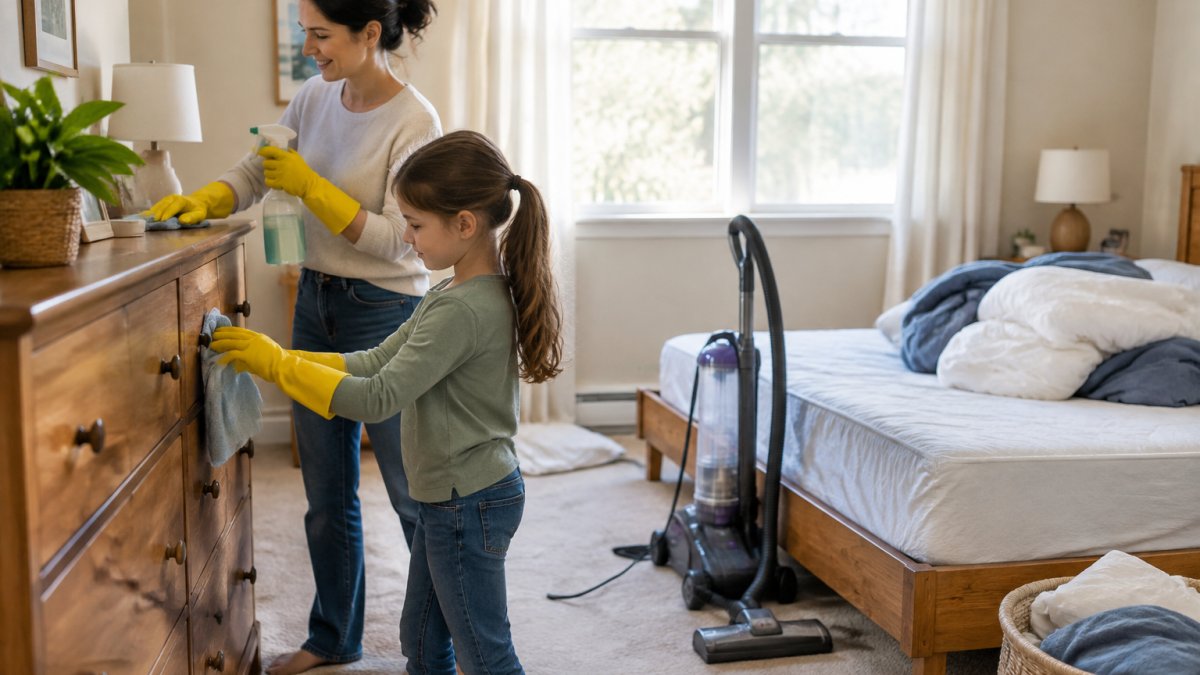
A practical routine, with the order mattering, is:
- Bedroom first. Wash bedding weekly in hot water. Wipe the headboard and nightstand with a damp cloth, not a dry one.
- Living room next. Vacuum upholstery and carpets with a HEPA filter vacuum. Damp dust the shelves.
- Kitchen. Wipe hard surfaces with a fragrance-free cleaner. Clear crumbs that feed pests.
- Bathroom. Target mold in grout and corners. Run the fan during and after cleaning.
- Floors last. Vacuum, then mop, so you are not pushing dust back onto clean surfaces.
Damp dusting is the quiet hero here. A dry cloth just lifts dust into the air, where you breathe it. A damp one traps it.
A 2024 review in PubMed Central on reducing indoor allergen exposure found that removing carpets or furniture coverings may reduce dust mite and allergen exposure, though the overall evidence is limited. Since carpets can hold onto dust and other allergens, choosing gentle methods to remove allergens from carpets can be one practical part of a broader effort to reduce exposure.
| Room | Main Allergen | Best Tool | Frequency |
|---|---|---|---|
| Bedroom | Dust mites | Hot-water laundry, damp cloth | Weekly |
| Living room | Pet dander, dust | HEPA vacuum, damp dusting | Twice weekly |
| Kitchen | Crumbs, mold | Fragrance-free surface cleaner | Daily wipe-down |
| Bathroom | Mold | Ventilation, mold cleaner | Weekly |
| Floors | Pollen, dust | HEPA vacuum, then mop | Weekly |
DIY Cleaning Recipes: Safe Use and Limitations
DIY cleaning recipes work well for light jobs: vinegar and water for glass, baking soda paste for sinks, and castile soap for general wiping.
Where DIY shines:
- Glass and mirrors with diluted vinegar (about one part white vinegar to one part water)
- Sinks and tubs with a baking soda paste (three parts baking soda to one part water)
- Light dusting with a damp microfiber cloth
- Freshening drains with baking soda followed by hot water
Where DIY falls short:
- Killing mold on porous surfaces. Vinegar may inhibit surface mold, but it does not penetrate grout or drywall. For persistent mold, moisture control and an appropriate mold cleaner are needed.
- Disinfecting after illness. DIY recipes are not tested disinfectants. If someone in the home is sick, use a product labeled as a disinfectant according to its directions.
- Cutting heavy kitchen grease. Baking soda and vinegar are not strong degreasers. A plant-based surfactant cleaner is more effective.
- Anything that needs a measured, tested formula. Homemade recipes vary in concentration, so results are inconsistent.
Surface compatibility matters as much as the recipe.
Dilution is where DIY goes wrong most often. Too strong a vinegar solution can leave residue and smell; too weak does not clean.
Watch out: never mix vinegar and bleach. It releases chlorine gas.
The other limit is consistency. A homemade spray made fresh each week works. One that sits for months in a warm cupboard may not.
Choosing Natural Ginesis Products for Your Sensitive Household
Choosing cleaning products for a sensitive household comes down to trust: a full ingredient list, no harsh fumes, and a formula that does its job. That is the standard we hold ourselves to at Natural Ginesis.
Our non-toxic, bio-degradable formulas use a unique organic blend of enzymes. They are built to remove dirt, germs, bacteria and odors without the harsh chemical load.
What we can tell you plainly:
- Our products are non-toxic and pesticide-free
- Our ingredients are bio-degradable
- Our formulas are safe for body, home and pets
- Our enzyme blends help eliminate common pests like lice, bed bugs and fleas
We will not pretend a "non-toxic" label makes a product risk-free. Use everything as directed, keep rooms ventilated, and patch test if your skin is sensitive.
If you have a child with a sensitive scalp or a pet with a flea problem, start with one product and see how the household responds. Then build your routine from there.
Frequently Asked Questions
What is the best cleaner for removing allergens?
There is no single best cleaner. Allergen removal depends more on method than on brand: damp dusting with a microfiber cloth, HEPA vacuuming, and washing bedding in hot water remove dust mites, pet dander, and pollen. For surfaces, choose a fragrance-free, dye-free non toxic cleaning product and check the label for irritant warnings. The EPA notes that even green products may contain chemicals linked to eye, skin, or respiratory irritation, so ventilation and rinsing matter as much as the formula.
Which cleaning products are best for people with allergies or asthma?
Look for asthma and allergy friendly cleaning products that are fragrance-free and dye-free, with short ingredient lists you can read. Avoid aerosol sprays, which send fine particles into the air, and skip products with strong perfumes or chlorine bleach if someone in the home has asthma. Industry guidance generally stresses that no cleaning product is entirely risk-free, so follow dilution and ventilation instructions.
Can fragrance-free cleaning products help people with sensitivities?
Yes. Fragrance is one of the most common triggers of eye, skin, and respiratory irritation from cleaning products, and the EPA cautions that green products may still contain irritants. Choosing fragrance-free and dye-free formulas removes a major source of fumes and residue. Pair them with ventilation and damp dusting to reduce airborne particles.
How often should I clean to reduce allergens at home?
A practical schedule: damp dust hard surfaces weekly, vacuum carpets and upholstery with a HEPA filter at least weekly (twice weekly in bedrooms), wash bedding in hot water every one to two weeks, and clean floors every few days in high-traffic areas. Research on removing carpets to cut allergen exposure suggests the evidence is limited, so consistent cleaning frequency matters more than one-off deep cleans. Adjust upward during pollen season or if pets sleep in bedrooms.
Allergens rebuild faster than most of us expect, so the goal is not one deep clean. It is a simple routine you will actually keep. Natural Ginesis makes that easier with non-toxic, bio-degradable formulas, a unique organic enzyme blend, and products safe for body, home and pets. Get started with Natural Ginesis and build a cleaning routine your whole household can breathe easy in.
