

24th Nov 2026
Why Natural Lice Treatments Are Better for Families
Last Updated: November 24, 2026
Quick Summary
Natural lice treatments are non-pesticide approaches that remove or suffocate lice and eggs without conventional insecticides, trading speed for safety and repeatability. They work best when a treatment that loosens eggs is combined with fine-toothed combing repeated over 10 to 14 days, since killing eggs is hard but removing them works.
- A lab assessment found most home remedies did little to kill lice eggs, though petroleum jelly performed best.
- Wet combing takes 30 to 45 minutes per session, every 2 to 3 days for two weeks.
- A 2012 study tracked cure rates of 20% after one treatment, 37% after two, and 90% after three.
- You cannot reliably clear a lice infestation in one day, but you can complete a full first-round treatment.
- Most treatment failures are incomplete routines, not resistant lice.
Table of Contents
- What Makes Natural Lice Treatments Different
- The Best Lice Treatment Depends on What You Need It to Do
- What Home Remedies Will Kill Lice Eggs (and What Won't)
- Finding the Best Head Lice Treatment for Long Thick Hair
- How to Get Rid of Lice Naturally in One Day
- Safety, Side Effects, and Who Should Avoid Certain Treatments
- When Natural Treatments Fail: Resistance and Reinfestation
- Choosing a Non-Toxic Lice Kit for Your Household
- Frequently Asked Questions
What Makes Natural Lice Treatments Different
Natural lice treatments are non-pesticide approaches that aim to remove or suffocate lice and eggs without conventional insecticides.
Here is the part that surprises people. A laboratory assessment of home remedies published in PubMed found that most tested home-remedy products did little to kill lice eggs, even after prolonged exposure.
So "natural" is not a guarantee of anything. What separates a good natural treatment from a bad one is whether it has a real mechanism, a realistic routine, and a plan for the eggs.
The Best Lice Treatment Depends on What You Need It to Do
The best lice treatment is the one that matches your situation: hair type, age of the child, previous treatment failures, and how much time you can realistically commit. There is no single winner.
That framing matters because most product pages sell one answer. In practice, lice treatment breaks into three families, and each has a different job. Before comparing them, it helps to define the categories precisely, because the word "natural" is used loosely in this market.
What Counts as a "Natural" Lice Treatment?
A useful definition separates three things that are often lumped together:
- Botanical or enzyme-based products, plant oils, essential oils, and enzyme formulas that aim to suffocate, loosen, or physically disrupt lice and eggs. These are what most people mean by "natural."
- Physical or non-pesticide methods, wet combing, nit combing, and occlusive substances such as dimethicone or petroleum jelly that coat and smother lice. These contain no insecticide, but they are not botanical remedies either.
- Conventional pesticides, shampoos and lotions containing neurotoxic active ingredients such as permethrin or pyrethrins, regulated as medicines in most countries.
Grouping wet combing and dimethicone under "natural" is common but misleading: it makes botanical products look more effective than they are, and it makes physical methods look more exotic than they are. The honest comparison is between mechanisms, not marketing labels. Judging natural hair care products by their ingredients and intended use, rather than by the label “natural,” is especially important when choosing what to use on children.
Natural vs. Chemical: A Side-by-Side Comparison
| Category | How it works | Strength of evidence | Strengths | Weaknesses | Real-world burden |
|---|---|---|---|---|---|
| Botanical oils and enzymes | Suffocation, loosening eggs, physical removal | Mixed; few products tested rigorously, and egg-kill data is weak | Gentle on scalp, safe for repeated use, no pesticide exposure | Slower; egg removal still required; irritation risk from essential oils | Moderate: repeat applications plus combing over 10-14 days |
| Physical (wet combing) | Manual removal with a fine-toothed comb | Good when technique and schedule are followed | No ingredients at all; no resistance mechanism | Time-intensive; depends entirely on combing thoroughness | High: 30-45 minutes per session, every 2-3 days for two weeks |
| Occlusive substances (dimethicone, petroleum jelly) | Coats and smothers lice; may slow egg hatching | Moderate; petroleum jelly showed the best egg effect in lab testing but not a bathroom guarantee | Non-pesticide; low irritation risk for most skin | Messy; hard to wash out of long or thick hair | Moderate to high depending on hair length |
| Chemical pesticides | Neurotoxic action on lice | Historically strong, now variable where resistance exists | Fast knockdown when lice are susceptible | Resistance, skin irritation, age restrictions | Low: often one application, but retreatment may be needed |
The honest read: natural and physical methods trade speed for safety and repeatability. Chemical shampoos trade safety margin for speed. Neither is universally better, and the deciding factor is usually not the product at all, it is whether the routine gets completed.
The Variable Most Comparisons Ignore: Treatment Burden
Efficacy tables rarely capture what actually determines success: whether a family can finish the course.
A common pattern in clinical practice is that "treatment failure" is really "treatment not completed." When you compare options, score them on three practical questions:
- How many sessions does the full course require, and how long is each one?
- How much mess and cleanup does the method create in a household with children?
- Can the same product be safely repeated for two weeks without irritating the scalp?
A method that wins on all three is usually the better choice for a real household, even if its lab kill rate is lower than a pesticide's.
Watch out: choosing a fast-acting pesticide because it seems more convenient, then skipping the follow-up comb, is one of the most common routes to a persistent infestation.
What Home Remedies Will Kill Lice Eggs (and What Won't)
Most home remedies do not reliably kill lice eggs. That is the uncomfortable finding from the research, and it should reshape how you plan treatment.
Researchers assessing home remedies reported that most tested products had little effect on egg mortality.
What this means practically:
- Coconut oil may help with adult lice, but Baystate Health guidance notes it does not kill nits attached to hair.
- Olive oil is described by experts as slowing lice movement, not eliminating eggs.
- Mayonnaise, vinegar, and tea tree oil are messy and inconsistently studied.
The reliable path is combining a treatment that loosens eggs with a fine-toothed comb and repeating the combing over 10 to 14 days.
Finding the Best Head Lice Treatment for Long Thick Hair
Long, thick hair is where most treatment plans fall apart. The product is rarely the problem; coverage and combing time are.
A 2012 study by Mac-Mary and colleagues tracked cure rates of 20% after one treatment, 37% after two, and 90% after three.
For long hair, we suggest:
- Section hair into small clips and treat one section at a time
- Use enough product to saturate from root to tip, not just the scalp
- Comb wet, conditioned hair with a metal fine-toothed comb
Watch out: skipping the comb because the hair is tangled is the single most common reason treatment fails in thick hair.
Cure rates after one, two, and three lice treatments
How to Get Rid of Lice Naturally in One Day
You cannot reliably clear a lice infestation in one day, but you can complete a full first-round treatment and set up the follow-up that actually finishes the job.
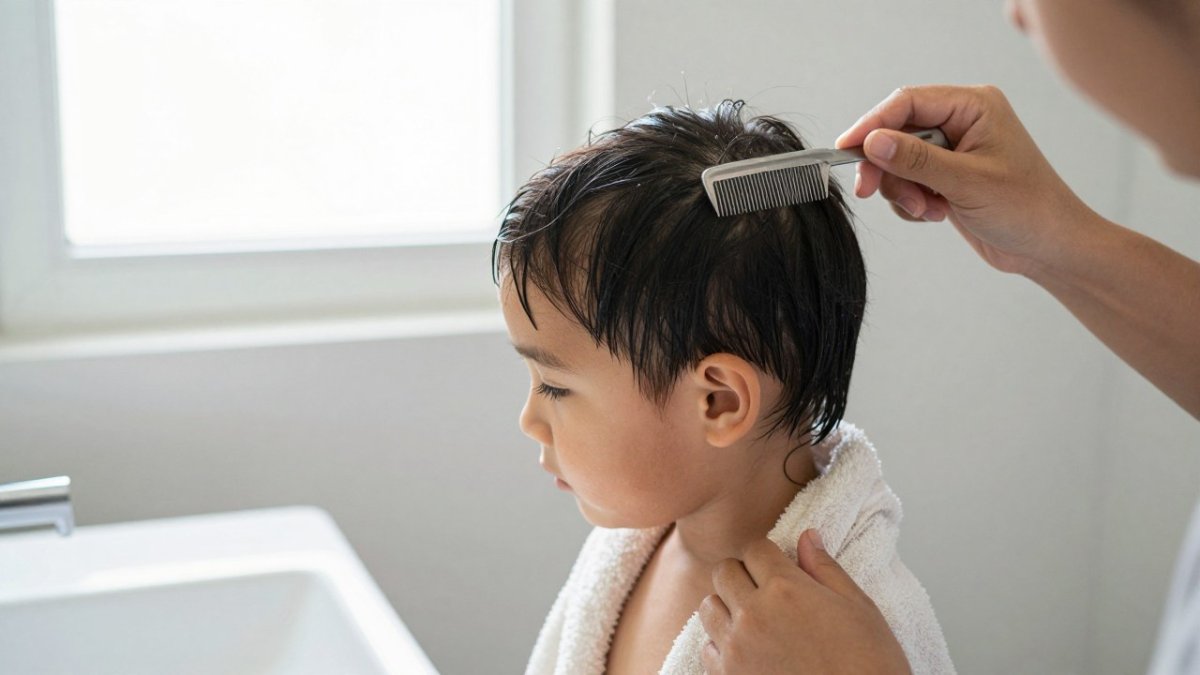
Here is the one-day plan we recommend:
- Wash hair and apply conditioner to loosen tangles
- Apply your natural treatment generously, root to tip
- Leave it on for the full time on the label, no shortcuts
- Comb section by section with a metal nit comb, wiping the comb on a paper towel each pass
- Wash out, then inspect under bright light
- Wash bedding and clothing used in the last 48 hours on a hot cycle
- Repeat combing every 2 to 3 days for two weeks
Day one gets you control. Days two through fourteen get you clearance.
Safety, Side Effects, and Who Should Avoid Certain Treatments
Natural does not mean risk-free. Essential oils can cause skin irritation and allergic reactions, particularly in young children, and "plant-based" says nothing about whether a product is safe for a given person.
International recommendations on head louse control state that products used to treat head lice should be regulated and approved by the relevant national health authority. That standard applies to natural products too, a botanical formula sold without oversight is not automatically gentler than a regulated medicine.
A Decision Guide by Age and Health Status
Most safety advice stops at "patch test first." A more useful approach is to match the treatment category to the person, because the same product can be appropriate for one family member and wrong for another.
Infants and toddlers (under 2 years)
- Wet combing is generally the first-line option because it introduces no ingredients at all.
- Check with a clinician before any essential oil product; the skin barrier in this age group is thinner and reactions are more likely.
- Occlusive substances such as petroleum jelly are often better tolerated than botanical oils, but confirm with a pharmacist.
Young children (roughly 2 to 12 years)
- Botanical and enzyme products are commonly used, but dilution matters: undiluted essential oils are a frequent cause of scalp redness and itching.
- Physical combing remains the safest adjunct and should be part of any routine regardless of product.
- Keep products away from the eyes and mouth, and rinse thoroughly.
Pregnancy and breastfeeding
- Confirm any product, botanical or conventional, with a pharmacist or clinician before use.
- Physical methods carry the least systemic exposure and are often preferred as a first step.
- Avoid inhaling concentrated essential oil vapors for prolonged periods.
Asthma and respiratory sensitivity
- Strong essential oil fumes, particularly eucalyptus and peppermint, can trigger symptoms in sensitive individuals.
- Use products in a well-ventilated room, and consider a physical method if fumes are a concern.
Eczema, psoriasis, and sensitive skin
- Patch test on the inner forearm 24 to 48 hours before full application.
- Prefer fragrance-free or single-ingredient formulas, and avoid products with alcohol or strong surfactants.
- If the scalp is already broken or inflamed, treat the skin first and consult a clinician.
Known plant allergies
- Avoid any product containing the specific oil or plant family you react to; cross-reactivity between related botanicals is common.
- Read the full ingredient list, not just the front label.
Side Effects to Watch For
Even appropriate products can cause:
- Contact irritation, redness, itching, or a burning sensation shortly after application
- Allergic contact dermatitis, a delayed rash appearing 24 to 72 hours later
- Eye or mucous membrane irritation from fumes or accidental contact
Stop use and rinse thoroughly if any of these appear, and seek advice if the reaction is widespread or breathing is affected.
Watch out: assuming a product is safe for a child because it is marketed as natural is the most common safety mistake in this category, age, skin condition, and allergies matter more than the label.
When Natural Treatments Fail: Resistance and Reinfestation
Treatment failure usually has one of three causes: missed eggs, missed lice, or reinfestation from a close contact.
A 2022 review of physically acting treatments notes that these methods showed high effectiveness when first introduced, which raises a fair question about how they perform now. The research does not give a clean number, so treat any confident claim with suspicion.
Troubleshooting checklist:
- Did you comb every 2 to 3 days for the full two weeks?
- Did you treat or check every close contact in the household?
- Did you wash bedding, hats, and hair accessories?
Most "failures" are incomplete routines, not resistant lice.
Choosing a Non-Toxic Lice Kit for Your Household
A good kit removes decisions.
What to look for in any kit:
- A metal comb with closely spaced teeth, not plastic
- A treatment you can repeat safely for two weeks
- Clear instructions with a combing schedule
Natural Ginesis offers non-toxic, biodegradable products for body, home, and pets. Pricing depends on quantity, dates, and delivery, so check the Natural Ginesis website for current prices or a quote.
Lice are persistent, and the internet is full of confident advice that does not survive contact with a squirming eight-year-old. What works is boring: a gentle treatment, a good comb, and two weeks of follow-through.
Frequently Asked Questions
Are natural lice treatments safer than chemical treatments?
Natural lice treatments avoid the pesticides found in many drugstore shampoos, which is a real advantage for children and people with sensitive scalps. That said, natural does not automatically mean risk-free: essential oils can still irritate skin or trigger allergic reactions. International guidance recommends using products regulated and approved by your national health authority, so check labels either way. The trade-off is usually time and mess rather than safety, since natural remedies often need repeated combing and application.
Do natural remedies kill lice eggs as well as live lice?
Most do not. A laboratory assessment of home remedies found that most tested products did little to kill lice eggs even after prolonged exposure, though petroleum jelly performed best with only 6% of treated eggs hatching. Coconut oil may kill adult lice but does not kill attached nits, according to Baystate Health. That is why egg removal with a fine-toothed comb matters so much: physical removal is the most reliable way to clear nits that a remedy leaves behind.
How do you get rid of lice naturally at home?
Start with wet combing: apply conditioner or a non-chemical treatment, then comb section by section with a fine-toothed metal comb, wiping the comb clean after each pass. Repeat every few days for at least two weeks to catch newly hatched lice before they lay eggs. Wash bedding and clothing in hot water and check close contacts. Because natural remedies vary in how well they work, plan for repeat treatments rather than a single application.
When should you use a medicated lice treatment instead of a home remedy?
Consider a medicated treatment if natural methods have not cleared the infestation after two to three weeks of consistent combing, if someone in the household has a compromised immune system or broken skin on the scalp, or if your health authority advises it. Drug resistance is a real concern, so if one medicated product fails, ask a pharmacist before switching. Either way, combining treatment with manual nit removal gives you the best chance of avoiding reinfestation.
